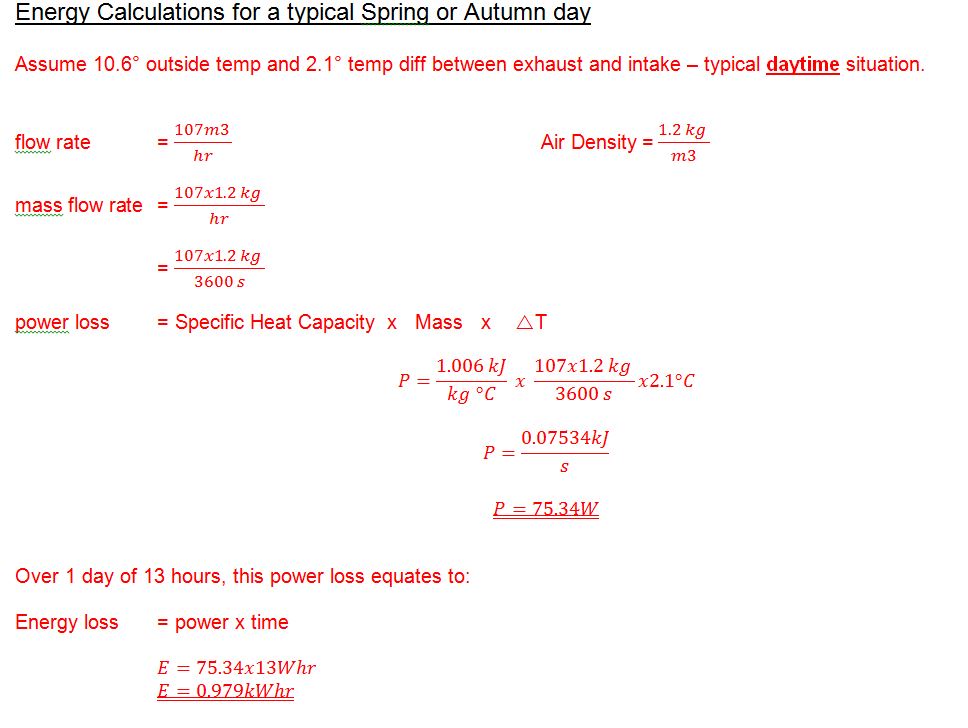
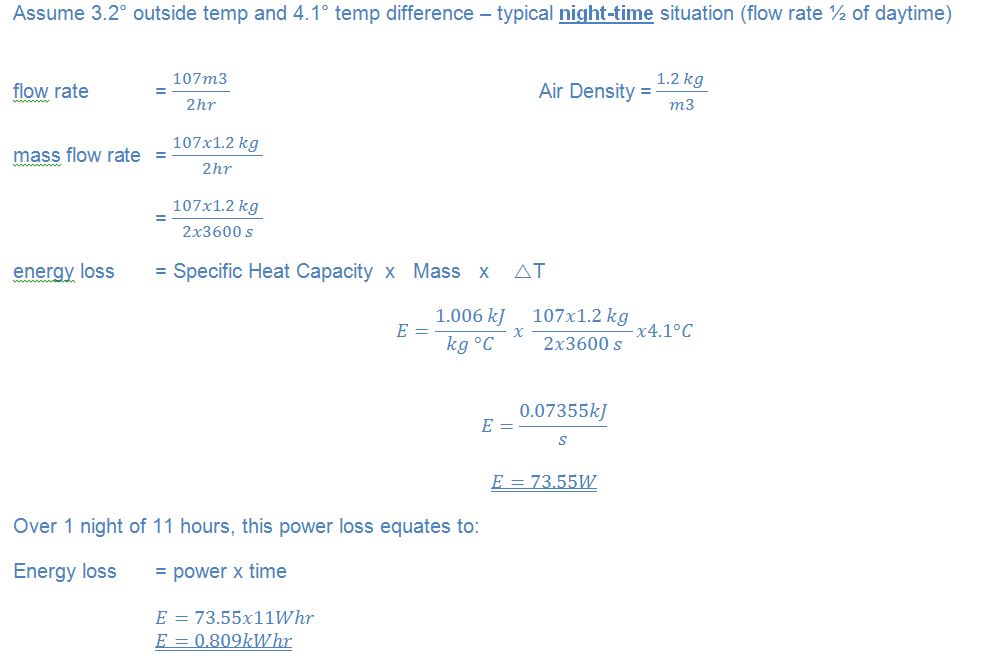
Together, the day and night-time figures give a 24hr loss of 1.8kWhr.
This would be replaced by the gas central heating,
which at a gas cost of 4p/kWhr would cost 7.2p
per day.
Similar calculations can be carried out for a winter scenario of daytime temperature 3.2° and night-time temperature of 1.1°
Air-borne energy loss in summer is assumed to be zero, inside and outside temperatures being similar
One can then pull together a very rough estimate for annual consumption as follows:
|
Season |
Number of days |
Fan kWhr per day - as measured by accurate wattmeter. |
Air loss kWhr per day |
Total Air kWhr |
|
Spring + Autumn |
165 |
0.6 |
1.8 |
297 |
|
Winter |
100 |
0.6 |
2.96 |
296 |
|
Summer |
100 |
0.6 |
0 |
0 |
|
Annual total |
365 |
219 |
|
593 |
|
kWhr cost |
13p (electricity) |
|
|
4p (gas) |
|
|
|
£28.47 |
|
£23.72 |
This equates to an annual total running cost of about £52.19. Note that this is based on many assumptions!
It is impossible to cost traditional ventilation arrangements, namely
opening windows as and when it seems appropriate.
An alternative energy consideration, namely comparison with our previous
house, is interesting. This was a 1990 traditionally built 90m2 (and not particularly air-tight)
bungalow which used traditional ventilation methods and radiator heating. Both houses are heated by gas. There are no other warmth providers to either
house, such as wood burning stove, solar panels, etc.
The total annual gas + electricity consumption in our new house of 94 kWhr/m2 per annum is about 52% of that for our previous house.
Which part of
that saving is due to insulation and which to the airtight construction with
HRV is impossible to determine in this simplistic analysis
Final thoughts :
Germany
I discovered that some German builders were becoming aware of an issue concerning the air-tight wall and ceiling membranes being inadequately sealed around cables, or punctured during construction, etc.
Tiny air leaks carrying damp air from a damp area within the house might cool on their way out through a wooden wall structure in winter to the point where condensation might occur. This could encourage mould or rot in the wall structure of a house.
To avoid these problems, some German builders now aim to have a slight negative pressure in the house and strenuously avoid an overpressure.
An HRV system with 2 fans can achieve this by ensuring the incoming fan is running slightly slower than the outgoing fan.
I doubt if this is realistic........................
Finland
A further issue has been noted in Finland concerning Radon gas within the house.
To reduce the amount of this naturally occurring gas seeping into a house, some Finnish HRV specialists suggest the opposite of the above, namely to have a small positive pressure in the house.
I have no views on this!